

Quartz (Engineered Stone)
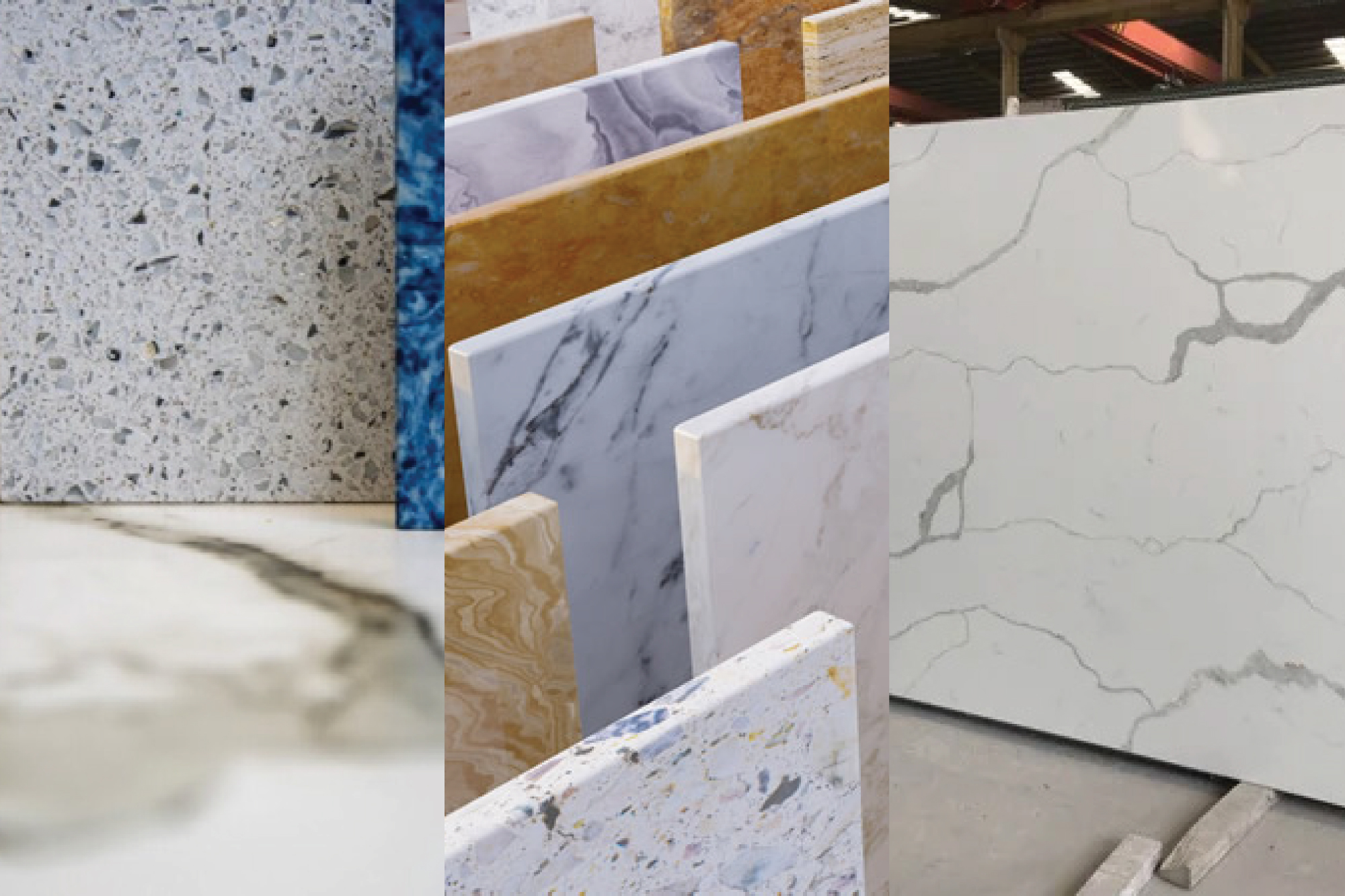
Engineered for Modern Living
Durable quartz surfaces with low porosity, scratch resistance, and elegant finishes, ideal for kitchens, vanities, and commercial spaces, ensuring long-lasting performance, certified safety, and contemporary design possibilities for global projects.
Use:
kitchen and vanity countertops, lab tops, hospitality & retail fit outs.
Format:
jumbo slabs; typical sizes up to ~3200 × 1600 mm (varies by factory).
Thickness:
12 / 15 / 20 / 30 mm.
Finishes:
Polished, Matte/Honed, Textured.
Performance:
stain resistant, low porosity, high scratch hardness; food prep friendly formulations available (factory certifications on request
QC
resin ratio control, color consistency, flatness, edge chip resistance; thermal shock and stain tests on request.
Types Of Quartz
Composition and Formation
Quartz is one of the most abundant and versatile minerals on Earth, composed mainly of silicon dioxide (SiO₂).
It forms naturally in igneous, metamorphic, and sedimentary rocks and appears in a wide range of colors, textures, and crystal forms.
Quartz is used both as a gemstone and as a building/decorative stone (including engineered quartz surfaces).
Clear Quartz :
Purest form of quartz, often used in jewelry and electronics.
Amethyst :
Colored by iron and radiation; highly valued gemstone.
Citrine :
Heat-treated amethyst or smoky quartz; used in jewelry.
Smoky Quartz :
Natural irradiation gives it smoky hue.
Rose Quartz :
Contains trace amounts of titanium or manganese; popular in décor.
Milky Quartz
Caused by gas or liquid inclusions during crystal growth.